Product & engineering are the core of a tech company. For many startups I work with, it is the biggest areas of investment – in terms of both dollars and people. But prioritizing product and engineering initiatives and measuring the ROI of those efforts can be challenging.
When a startup is in its early days, there are few resources to allocate. The small org is working toward one goal – building and iterating to achieve product-market fit. As a business matures, specialist pods form and various product and engineering initiatives emerge.
There are infinite things you can build. But resources are limited, so what do you prioritize and why? How much do you decide to invest more in the core vs. expand vs. pursue the risky new opportunity that could become your AWS?
Here is a simple framework I’ve been iterating on with my portfolio companies:
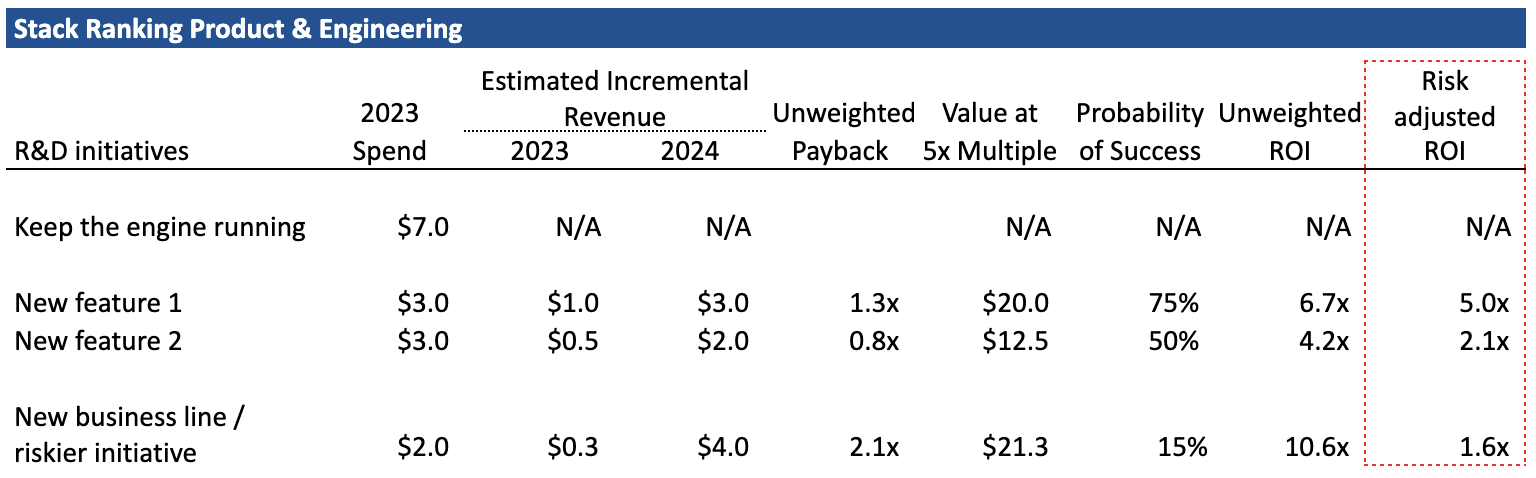
Here is how it works:
1. Allocate R&D spend and headcount into two buckets:
- Keep the engine running – These are the ongoing expenses necessary to support the core products and serve customers well. Think: bug fixes, up-time, security and compatibility updates, etc. These activities are akin to COGS in that they are ongoing and needed to support the status quo well, but do not necessarily lead to business expansion.
- New initiatives (everything else!) – List all other key product initiatives including new product modules, major features, expansion initiatives, etc. Allocate the people/spend dedicated to each initiative as best you can.
2. Stack rank by impact and cost – work with teams to estimate incremental revenue (or gross profit) that each initiative will yield within 2 years. Probability weight each initiative.
- Incremental investments should have justification. For example, initiative 1 requires $2m and addresses the reason you lost ~$3m deals last year.
- Unprofitable companies have less time to see ROI, hence the 2 year constraint. Ship fast.
- Entering a totally new business line may have the highest potential ROI, but its low probability of success means that it is not the highest ranked initiative. It may still be worthy, but needs to be sized / sequenced appropriately.
Investing in the future and being a sustainable business shouldn’t be in conflict. As a founder, one of your primary responsibilities is resource allocation. That means allocating people and their time effectively.
Important notes:
- Best-in-class high growth companies reach >$50m revenue with <30% of R&D allocated to “keeping the engine on.” This way, most of the team and cost is dedicated to improvements, future growth, and expansion.
- Experiment, but keep the main thing, the main thing. What is must do vs. can be sequenced? The more initiatives you have, the lower your odds of success.
- The more profitable the core product, the more you can allocate to lower probability, longer dated but high potential initiatives. Some use the 70/20/10 rule: invest 70% improving the core business, 20% in adjacent developments, and 10% in totally new or transformational areas. It is a nice benchmark, but the more profitable, mature, or dominant the core, the more you should invest in the new. If earlier in that journey, focus more on the core.
- Time bound incremental revenue at 2 years. Without this, the ROI is highly speculative and harder to justify. At least for the unprofitable. The constraint also forces a focus on speed, which is one of a startup’s most important advantages. An alternative is to ascribe a much lower probability of success to revenue beyond 2 years out (i.e., 2025 or later in today’s 2023 context). Constraints drive innovation.
- Make room for experimentation and innovation. The best way to learn what works is to try things out.
There are well established frameworks for assessing the ROI of go-to-market. Like CAC payback, magic number, quota to OTE. For product and engineering, it is mushy. At board meetings, I see things like feature launches, PRs merged, uptime. But rarely is it tied to customer or business outcomes.
Hopefully this serves as a useful tool in the toolkit.

 Talia Goldberg
hello
Great post! Allocating resources is such an important aspect of product development and engineering. It’s great to see thoughtful insights on how to maximize their value. Thanks for sharing!
Discount Coupons- http://KuciaKodes.uk